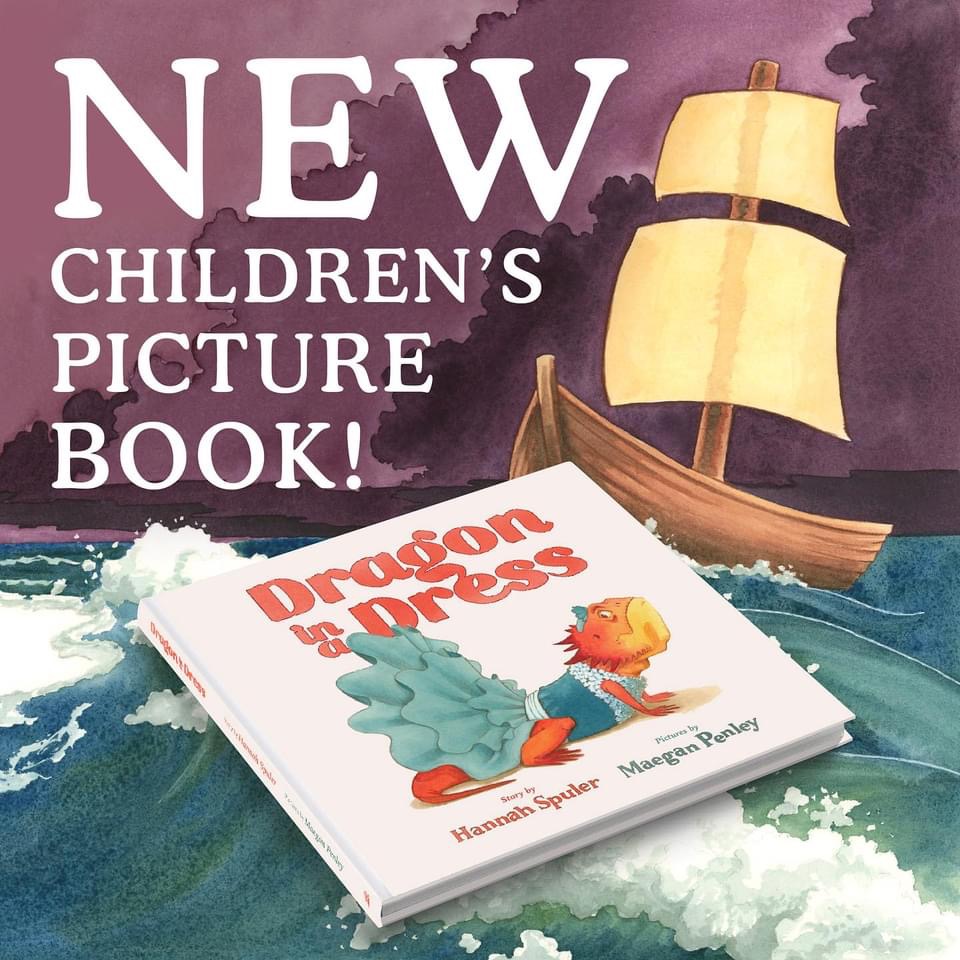
Dragon in a Dress is available for preorder!
Click the link below to preorder the book and make an author happy :)
https://canonballbooks.com/products/dragon-in-a-dress/

Bringing truth, goodness and beauty to children~ one whimsical (and sometimes silly!) story at a time.

Dragon in a Dress is available for preorder!
Click the link below to preorder the book and make an author happy :)
https://canonballbooks.com/products/dragon-in-a-dress/
Hello! Welcome to Poetry Tuesday: the day we dip (or dive) into the lovely world of poetry!
Each Tuesday from June 19 to August 21, 2018, I’ll share a Poetry Activity, a Poem Study, plus an Advanced Poetry Lesson. Feel free to enjoy one, two, or all three of these fun resources! (Click on the title links)
Poetry Activity (for kids, adults, and everyone in between): Concrete (Shape) Poem
Poem Study: Eletelephony by Laura Elizabeth Richards
Advanced Poetry Lesson: Sonnets, Week 2

Hello! Welcome to Poetry Tuesday: the day we dip (or dive) into the lovely world of poetry!
Interested in poetry?
Write a concrete (shape) poem in this activity for kids, adults, and everyone in-between.
A. Introduction to Concrete Poems
Concrete poems are a special kind of poetry in which the words themselves make a shape! It’s fun, it looks neat, and most importantly, it makes the poem come alive to the reader in a unique way.
Here’s an old example of a concrete poem. It was written by George Herbert, who lived from 1593 to 1633 in Europe. If you turn it sideways, it looks like two sets of Angel Wings!
Angel Wings
Lord, who createdst man in wealth and store,
Though foolishly he lost the same,
Decaying more and more,
Till he became
Most poore:
With thee
O let me rise
As larks, harmoniously,
And sing this day thy victories:
Then shall the fall further the flight in me.
My tender age in sorrow did beginne
And still with sicknesses and shame.
Thou didst so punish sinne,
That I became
Most thinne.
With thee
Let me combine,
And feel thy victorie:
For, if I imp my wing on thine,
Affliction shall advance the flight in me.
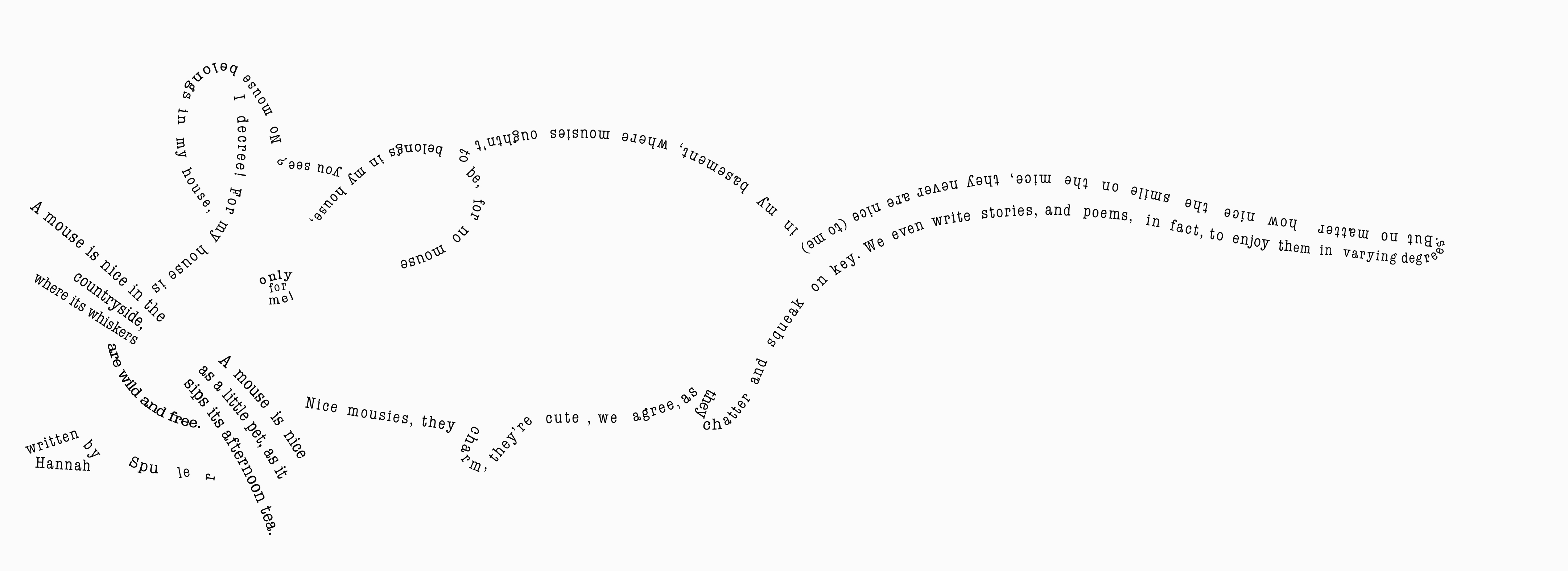
At the top of the page is a poem that I wrote when I was putting together this activity. It was inspired by a recent mouse incident we had in our basement!
See how it looks like a mouse? Sometimes you have to turn the paper to read all the way around a concrete poem!
B. Writing a concrete poem
Your turn!
1. Pick a simple shape. You can pick your own shape or print out one of these templates:
ball
star
butterfly (advanced)
paw print (advanced)
2. Write a poem about your shape on a separate piece of paper. Even though my poem rhymed, yours absolutely doesn’t need to. Just write words to describe your shape.
3. Write your poem around the shape!
4. Would you like your concrete poem to be only words and no drawing marks? Here’s a mini-tutorial to help:
a. Trace your shape with a dark marker
b. Place a clean piece of white paper on top of your shape so the shape shows through
c. Write your poem on the white paper, using the shape underneath as a guide
Pleased with your poem? Snap a picture of it and share it in the comments or post it on my
Facebook page so we can all read and enjoy them!
Hungry for more? Check out this week’s…
Poem Study: Eletelephony by Laura Elizabeth Richards
Advanced Poetry Lesson: Sonnets, Week 2
Let’s write some poetry!
This Tuesday and last we’ve been writing sonnets!

A. Introduction to Sonnets:
Why on earth would you want to write a sonnet?
I’m so glad you asked! It’s easy to hear the word “sonnet” and the phrase “iambic pentameter” and be thoroughly unimpressed. So here’s a list of why sonnets are a fantastic poetry form:
Why sonnets?
B. Sonnet Examples
Sonnet III
Look in thy glass, and tell the face thou viewest
Now is the time that face should form another;
Whose fresh repair if now thou not renewest,
Thou dost beguile the world, unbless some mother.
For where is she so fair whose unear’d womb
Disdains the tillage of thy husbandry?
Or who is he so fond will be the tomb
Of his self-love, to stop posterity?
Thou art thy mother’s glass, and she in thee
Calls back the lovely April of her prime:
So thou through windows of thine age shall see
Despite of wrinkles this thy golden time.
But if thou live, remember’d not to be,
Die single, and thine image dies with thee.
~William Shakespeare
Sonnet VII
O Solitude! if I must with thee dwell,
Let it not be among the jumbled heap
Of murky buildings; climb with me the steep,—
Nature’s observatory—whence the dell,
Its flowery slopes, its river’s crystal swell,
May seem a span; let me thy vigils keep
’Mongst boughs pavillion’d, where the deer’s swift leap
Startles the wild bee from the fox-glove bell.
But though I’ll gladly trace these scenes with thee,
Yet the sweet converse of an innocent mind,
Whose words are images of thoughts refin’d,
Is my soul’s pleasure; and it sure must be
Almost the highest bliss of human-kind,
When to thy haunts two kindred spirits flee.
~John Keats, 1795 – 1821
C. About Sonnets
Note to Beginners: I recommend starting with “What is a sonnet” below. The goal is fun exposure to poetry and a chance to practice writing. Once you’ve got that first set down, try “What is a sonnet (part 2).”
As I explain all the parts of a sonnet, look at the examples above to help you process.
What is a sonnet?
(Are you lost yet? If it’s really confusing, this Youtube video I found explains it pretty well.)
What is a sonnet (part 2)?
D. Write your sonnet
Do you feel ready to write your own sonnet? If you’re feeling overwhelmed, try four lines and then take a break. You can pick it back up after the break and write the next one!
Pleased with your poem? Share it on my Facebook page or in the comments!
Hungry for more? Check out this week’s…
Poetry Activity (for kids, adults, and everyone in between): Concrete (Shape) Poem
Poem Study: Eletelephony by Laura Elizabeth Richards
Ready for this week’s Story Share Topic?
Join in the fun! Write your story and send it in for a chance to have your story shared on the site!
This Week’s Story Share Topic:

Perhaps the character followed a strange smell and fell into trouble, or maybe his/her nose sniffed out an adventure! What was the smell? Why did the character want to follow it? What was at the end of the smell, if there was one? What is the problem (conflict)? How is it solved?
To share: Send your story next Friday to Fridaystoryshare@gmail.com
FAQ: If you don’t want to share your story, can you still write one? Absolutely!
Do you have to write a story on this particular topic? Nope! Writing stories is a great creative writing exercise, no matter what the topic. The topic is a prompt to get you started!
Writing with little ones? Read this post about how to include young children in writing activities.
Hello! Welcome to Poetry Tuesday: the day we dip (or dive) into the lovely world of poetry!
Each Tuesday from June 19 to August 21, 2018, I’ll share a Poetry Activity, a Poem Study, plus an Advanced Poetry Lesson. Feel free to enjoy one, two, or all three of these fun resources! (Click on the title links)
Poetry Activity (for kids, adults, and everyone in between): Five Senses Poem
Poem Study: Summer in the South by Paul Laurence Dunbar
Advanced Poetry Lesson: Sonnets (Week 1 of 2)
Hello! Welcome to Poetry Tuesday: the day we dip (or dive) into the lovely world of poetry!
Interested in poetry?
Write a five senses poem in this activity for kids, adults, and everyone in-between.

Note: This activity is brought to you by my very own poetry-loving mother, Elizabeth Thomas. Thanks, Mom, for all the love, support, and creative input you’ve given me over the years!
A. Observations using the five senses
I see
A dusty lampshade
Red suede couch cushions
A grape juice spill on the wooden floor
A cowboy boot sitting on
A grey and turquoise rug
The bare feet of
My husband
Write down all the things you hear, one on each line.
I taste
I smell
B. Crafting Your 5 Senses Poem
Welcome back! Hope you had a nice little break.
Did you know you just wrote a poem???
Take a look at your paper.
Pleased with your poem? Share it in the comments or post it on my Facebook page so we can all read and enjoy them!
Hungry for more? Check out this week’s…
Poem Study: Summer in the South by Paul Laurence Dunbar
Advanced Poetry Lesson: Sonnets (Week 1 of 2)
Ready for this week’s Story Share Topic?
Join in the fun! Write your story and send it in for a chance to have your story shared on the site!
This Week’s Story Share Topic:
What does the character do that’s so funny? What does he/she say? Or perhaps the situation they’re in is funny and the character gets swept away in it!
To share: Send your story next Friday to Fridaystoryshare@gmail.com
FAQ: If you don’t want to share your story, can you still write one? Absolutely!
Do you have to write a story on this particular topic? Nope! Writing stories is a great creative writing exercise, no matter what the topic. The topic is a prompt to get you started!
Writing with little ones? Read this post about how to include young children in writing activities.
Hello! Welcome to Poetry Tuesday: the day we dip (or dive) into the lovely world of poetry!
Each Tuesday from June 19 to August 21, 2018, I’ll share a Poetry Activity, a Poem Study, plus an Advanced Poetry Lesson. Feel free to enjoy one, two, or all three of these fun resources! (Click on the title links)
Poetry Activity (for kids, adults, and everyone in between): Limerick fill-in-the-blank
Poem Study: The Owl and the Pussycat by Edward Lear
Advanced Poetry Lesson: Limericks, Week 2
Hello! Welcome to Poetry Tuesday: the day we dip (or dive) into the lovely world of poetry!

Interested in poetry?
Construct a limerick in this activity for kids, adults, and everyone in-between.
A. Introduction to Limericks
Have you ever read a limerick? They sound a little like this…
The Jibbericky
There once was a poem named Limerick,
Who thought everything was a gim-er-ick.
It started to giggle,
Which made the words jiggle,
And mixed them all up into jibberick.
~Hannah Spuler
(Written in complete and utter silliness three minutes ago. The birds in my back yard are wondering what’s so funny)
Limericks are (often) silly poems that follow a certain pattern of beats (stresses) and rhymes. If you’re looking for a poem to make people laugh, a limerick fits the bill. No one is quite sure where the limerick started, but Wikipedia.org seems to think it’s as old as the early 1700’s. Oh, and there’s also a town of Limerick in Ireland which seems to have nothing to do with the poem. (Didn’t you want to know that?)
B. Limerick Example
Here’s an example from Edward Lear, master of the limerick. He wrote a book called A Book of Nonsense that’s full of all kinds of silly… nonsense. (Hm! Imagine that.) His book was full of limericks, which is actually what made the limerick a popular form today.
There was an Old Man with a beard,
Who said, “It is just as I feared!–
Two Owls and a Hen,
Four Larks and a Wren,
Have all built their nests in my beard!”
~Edward Lear (Book of Nonsense, 1)
C. Fill-in-the-Blank!
Now it’s time to write your own Limerick! To make it easy for you, I’ve made a form so you can just fill in the blanks.
Details in case you get stuck:
Form poem: Limerick
Still feeling stuck? Go back to the Edward Lear example and follow it as a model.
Note to parents: Limericks are fun for the whole family to write together! Small children like to come up with the character in the poem but might not be able to rhyme or do syllables on their own yet. That’s perfectly fine! Let them help as much as they’re able! By 4th or 5th grade many children will be able to contribute quite well.
Pleased with your poem? Share it in the comments or post it on my Facebook page so we can all read and enjoy them!
Hungry for more? Check out this week’s…
Poem Study: The Owl and the Pussycat by Edward Lear
Advanced Poetry Lesson: Limericks, Week 2
 Hannah Spuler